Are you stressed about getting your passport photo rejected? Applying for a passport or visa can be a daunting process, and the photo is often the trickiest part. With constantly evolving regulations and varying requirements across countries, ensuring compliance can feel like navigating a minefield. But don't worry, this comprehensive guide is here to help!
We'll equip you with the knowledge and tools you need to confidently navigate the complexities of passport photo requirements, minimizing the risk of rejection and ensuring a smooth application process in 2026. Learn about global standards, DIY tips, expert insights, and most importantly, how AI-powered tools can simplify the entire process.
## Why Passport Photo Compliance Matters
Submitting a compliant passport photo is crucial for several reasons:
* **Avoid Application Delays:** Non-compliant photos are a leading cause of passport and visa application delays.
* **Save Time and Money:** Rejections mean re-takes, leading to wasted time and money.
* **Ensure Accurate Identification:** Compliant photos ensure accurate facial recognition, vital for security.
* **Stress-Free Travel:** Knowing your documents are in order provides peace of mind for international travel.
## Decoding Global Passport Photo Standards in 2026
Passport photo requirements are primarily based on guidelines issued by the International Civil Aviation Organization (ICAO) and individual country regulations. Understanding these standards is the first step towards a successful application. Let's break down the key elements:
### Core Requirements:
* **Photo Size:** Most countries require a 2x2 inch (51x51 mm) photo. *Always verify the specific dimensions for the country you are applying to.*
* **Color:** Photos must be in color, not black and white.
* **Background:** A plain white or off-white background, free from shadows or patterns, is typically required.
* **Image Quality:** High resolution (minimum of 600 DPI), sharp focus, and proper lighting are essential.
* **Paper Quality:** It should be printed on high-quality, high-definition photo paper. Avoid Polaroid photos or those printed with ordinary printers.
* **Recency:** The photo should be recent, generally no more than 6 months old.
* **Alterations:** Photos should not be digitally altered or retouched in any way.
### Key Areas Where Requirements Differ:
* **Head Size:** The size of your head within the photo can vary slightly by country. Generally, the face should cover 70-80% of the photo from the base of your chin to the top of your forehead. Some sources specify that the face should take up 80-85% of the photograph.
* **Head Position:** Face directly into the camera at eye level. The head should be centered and not tilted. Both halves of the face must be clearly recognizable.
* **Facial Expression:** While a neutral expression is generally required, some countries might have slightly different interpretations of what constitutes a 'neutral' expression. The mouth should be closed.
* **Eyes:** Eyes must be open, clearly visible, and not obscured by hair.
* **Eyeglasses:** *Eyeglasses are generally not allowed in U.S. passport photos.* Some countries may have different policies. It's crucial to check the specific requirements of the country to which you're applying. If glasses are unavoidable due to a medical condition, provide a signed statement from your doctor.
* **Head Coverings:** Most countries prohibit head coverings unless worn for religious or medical reasons. If a head covering is worn, it must not obscure facial features, and you may need to provide a signed statement to verify the exception.
## DIY Passport Photo Mastery: Tips & Tricks for 2026
Taking your passport photo at home can save time and money. Here's how to ace it:
### Gear Up:
* **Smartphone or Digital Camera:** Use a device with a high-resolution camera (at least 12 megapixels is recommended).
* **Tripod (Optional):** A tripod helps stabilize your camera for sharper images. If you don't have a tripod, ask someone to take the photo for you.
* **Well-Lit Space:** Find a spot with ample, diffused natural light. Avoid direct sunlight, which can cause harsh shadows. A north-facing window often provides the most even lighting.
* **Plain White Background:** Use a white wall or hang a white sheet or poster board. Ensure the background is smooth and wrinkle-free.
### Step-by-Step Guide:
1. **Set Up Your Background:** Ensure your background is plain white or off-white and free from distractions. The background should extend slightly wider than your shoulders.
2. **Position Yourself:** Stand about 4-5 feet away from the background. This distance helps to minimize shadows and ensure even lighting.
3. **Lighting is Key:** Make sure your face is evenly lit, avoiding shadows or glare. If using artificial light, use two softbox lights positioned at 45-degree angles to your face.
4. **Strike a Pose:** Face the camera directly with a neutral expression, eyes open, and mouth closed. Relax your facial muscles and avoid squinting or raising your eyebrows.
5. **Check Your Attire:** Wear everyday clothing, avoiding uniforms or white tops that blend with the background. Choose a color that contrasts with the white background.
6. **Take Multiple Shots:** Take several photos (at least 5-10) to ensure you have a few options to choose from. Slight variations in facial expression or lighting can make a big difference.
### Leveraging AI for Compliance:
Even with the best DIY efforts, it's difficult to manually ensure your photo meets all the precise technical requirements. That's where AI-powered tools come in. Tools like AI Passport Photo can analyze your photo and automatically:
* **Crop and Resize:** Ensure your photo meets the exact size and aspect ratio requirements (e.g., 2x2 inches or 51x51 mm).
* **Remove Backgrounds:** Replace non-compliant backgrounds with a plain white one.
* **Check Biometric Data:** Verify that your head size, facial position, and expression are compliant with ICAO standards.
* **Adjust Lighting and Contrast:** Optimize image quality for optimal clarity and visibility.
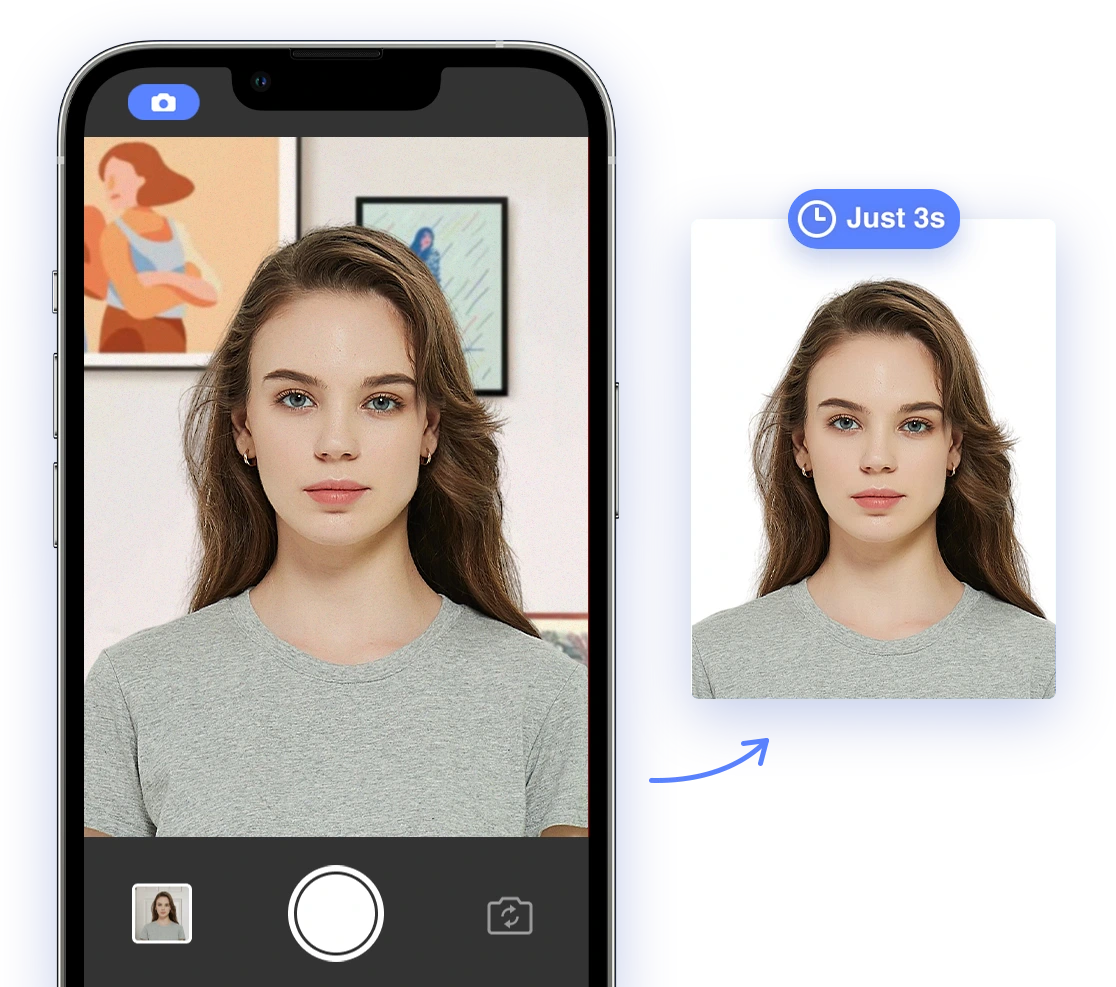
One tool you can use to help you in this process is the Passport Photo with iPhone, which will help you take your passport photo right from your iPhone!
## Common Passport Photo Mistakes and How to Avoid Them in 2026
Even with careful planning, it's easy to make mistakes. Understanding these common pitfalls and how to avoid them can save you time, money, and stress:
* **Incorrect Photo Size or Dimensions:** Always double-check the specific size requirements for your destination country. Use AI tools to automatically crop and resize your photo to the correct dimensions. See Passport Photo Size in the U.S.
* **Poor Lighting:** Avoid shadows and glare by using diffused natural light or soft artificial lighting. Ensure your face is evenly lit. Shadows behind the head or on the face are common rejection reasons. See How to Get the Best Passport Photos?
* **Non-Neutral Expression:** Practice a relaxed, neutral expression with your eyes open and mouth closed. Avoid smiling, frowning, squinting, or raising your eyebrows. A slight, natural smile is sometimes acceptable, but it's best to err on the side of caution and maintain a neutral expression. See Is it okay to smile in a passport photo?
* **Wearing Glasses (When Prohibited):** As of November 1, 2016, eyeglasses are generally not allowed in U.S. passport photos. Check specific country requirements for glasses. If glasses are medically necessary, provide a signed statement from your doctor explaining the necessity. Also note our article about Passport Photo with Glasses: Requirements, Tips & AI Solutions [2024-2025]
* **Improper Attire:** Avoid wearing uniforms, white clothing (which can blend with the background), or clothing that obscures your face or neck. Low-cut tops or clothing with distracting patterns should also be avoided. Opt for simple, everyday clothing in a color that contrasts with the background. Looking Your Best for Your U.S. Passport Photo What to Wear.
* **Head Coverings (When Not Allowed):** Only wear head coverings for religious or medical reasons. Ensure your facial features are clearly visible, and provide necessary documentation, such as a signed statement explaining the religious or medical need for the head covering. The head covering should not cast shadows on your face.
* **Digital Alterations:** *Never* use filters or editing tools that alter your appearance. Minor adjustments to brightness or contrast may be acceptable, but avoid anything that changes your facial features, skin tone, or eye color. The goal is to represent your true likeness.
* **Wrong Background:** Always use a plain white or off-white background free from distractions. AI tools can help remove or replace non-compliant backgrounds.
What happens when your passport photo is rejected? This article has the answer.
What if you need a child passport photo? The requirements might surprise you!
See the most common rejection reasons for id photos
## AI-Powered Passport Photo Tools: A 2026 Comparison
Several AI-powered tools can help you create compliant passport photos. Here's a comparison:
* AI Passport Photo Offers comprehensive compliance checks, background removal, and automatic cropping. Detailed guidance provided if the photo is not qualified, indicating what needs to be fixed. This tool guarantees that your photo will be accepted, or your money back.
* **Persofoto:** A popular app for various ID photos, including US passports. The app provides an accuracy level for the photo to ensure compliance.
* **PhotoAiD:** Boasts a high compliance rate and a user-friendly interface. You can upload a picture, and their AI will adjust to your country’s requirements.
* **Biometric Passport Photo:** Caters to all countries. Includes a comprehensive set of tools and checks to guarantee full compliance.
*Note:* While AI-powered tools offer significant advantages, it's essential to carefully review all options to understand what is offered and to ensure that it meets your specific needs. Check reviews, compare features, and consider free trials (if available) before making a decision.
## When Human Review Matters: Knowing When to Seek Professional Help
While AI tools are incredibly helpful, there are situations where professional assistance is recommended to ensure compliance:
* **Medical Conditions:** If you have a medical condition that affects your appearance or requires specific accommodations (e.g., head covering, medical device), consult with a professional photographer or passport acceptance agent. They can provide personalized guidance and ensure your photo meets all requirements while respecting your individual needs.
* **Infant Photos:** Taking passport photos of infants can be challenging. A professional photographer with experience in infant photography can help ensure the photo meets all requirements.
* **Unsure About Compliance:** If you're unsure whether your DIY photo meets all requirements, or if you've had previous photos rejected, seek a professional review. A trained eye can often identify subtle issues that AI tools might miss.
## Printing Your Passport Photo: Options and Best Practices
Once you have a compliant digital passport photo, you'll need to print it. Here are your options:
* **Print at Home:** Use a high-quality color printer and photo paper. Ensure your printer is set to print at the correct size (2x2 inches or 51x51 mm). Print a test sheet first to ensure the colors are accurate and the image is properly scaled.
* **Print at a Local Pharmacy or Retailer:** Many pharmacies and retailers, such as Walgreens, CVS, and Walmart, offer passport photo printing services. This is often a convenient and affordable option.
* **Online Printing Services:** Several online services, such as Amazon Print, allow you to upload your digital photo and have prints delivered to your door. This option is ideal if you need high-quality prints but don't have access to a suitable printer.
### Tips for Printing:
* **Use Photo Paper:** Print your photo on high-quality, glossy or semi-gloss photo paper for best results. Matte paper is generally not recommended.
* **Check the Print Quality:** Ensure your print is clear, sharp, and free from any blemishes, defects, or color distortions.
* **Cut Carefully:** Use a paper cutter or scissors to carefully cut your photo to the correct size. Use a ruler to ensure straight, accurate cuts.
## Key TakeAways for Stress-Free Passport Photo Approval in 2026
* Understand global passport photo standards and specific requirements for your destination country.
* Leverage AI-powered tools like AI Passport Photo to ensure compliance.
* Follow DIY tips for taking great photos at home, paying close attention to lighting and background.
* Avoid common mistakes related to size, lighting, expression, and attire.
* Seek professional help when needed, especially for complex situations.
* Print your photo on high-quality photo paper and cut it carefully to the correct size.
By following these guidelines, you can confidently take passport photos that meet all official requirements, minimizing the risk of rejection and ensuring a smooth application process. Safe travels!